
2026 INDUSTRY DATA REPORT
Children's Book Market Statistics 2026
The definitive, citable data resource for journalists, bloggers, industry analysts, and investors — covering market size, growth, AI impact, personalization, and competitive analysis.
Executive Summary
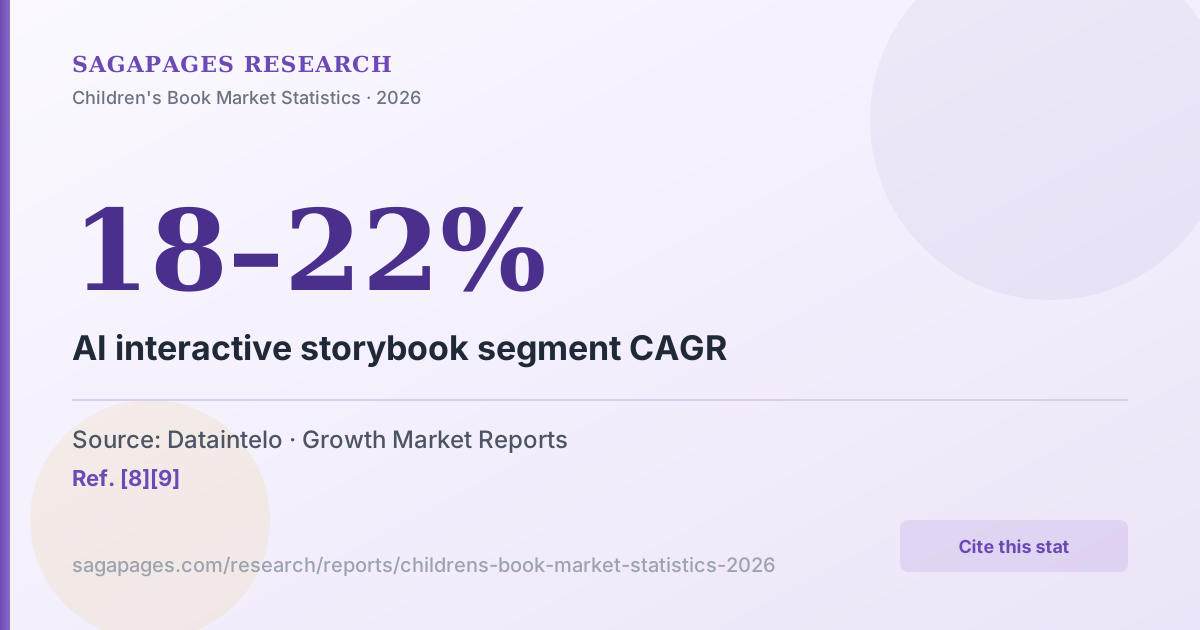
The global children's book market in 2026 stands at an inflection point. While the traditional publishing market grows at a steady 2.3–3.0% CAGR[1], AI-powered and personalized children's books are expanding at roughly 18–22% annually[8][9] — reshaping how stories are created, illustrated, and delivered to families worldwide.
Verified primary source
Triangulated estimate
Industry forecast
Vendor-reported
Three forces converging in 2026:
- AI production economics — Platform fees can reduce illustration cost from thousands of dollars per title to single-digit dollars per book, though quality and copyright trade-offs remain significant.[15][16]
- Personalization at scale — Validated by Penguin Random House's acquisition of Wonderbly (June 4, 2025), signaling major trade publishers' interest in D2C personalized books.[12]
- Print resilience — Physical books remain the dominant format for young children despite audiobook and digital growth.[3]
Figure 1 — How to read the numbers in this report
Market size figures vary by definition (children-only vs. YA-inclusive), geography, and channel (print, digital, licensing). We report ranges where sources disagree, link every major claim to a numbered reference, and flag vendor-reported platform data separately from third-party market research.
Cite & Share — Key Statistics
Download or embed these citation cards when referencing individual statistics. Each card links to the numbered reference in this report. For full-report attribution, use the APA/Chicago formats in Methodology.
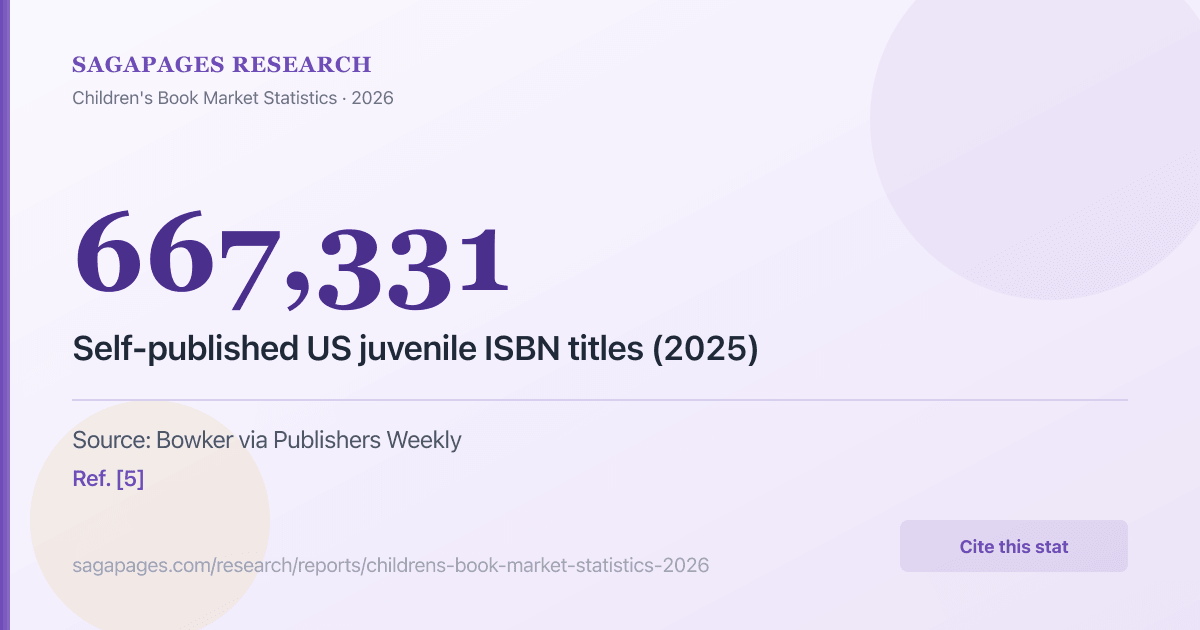
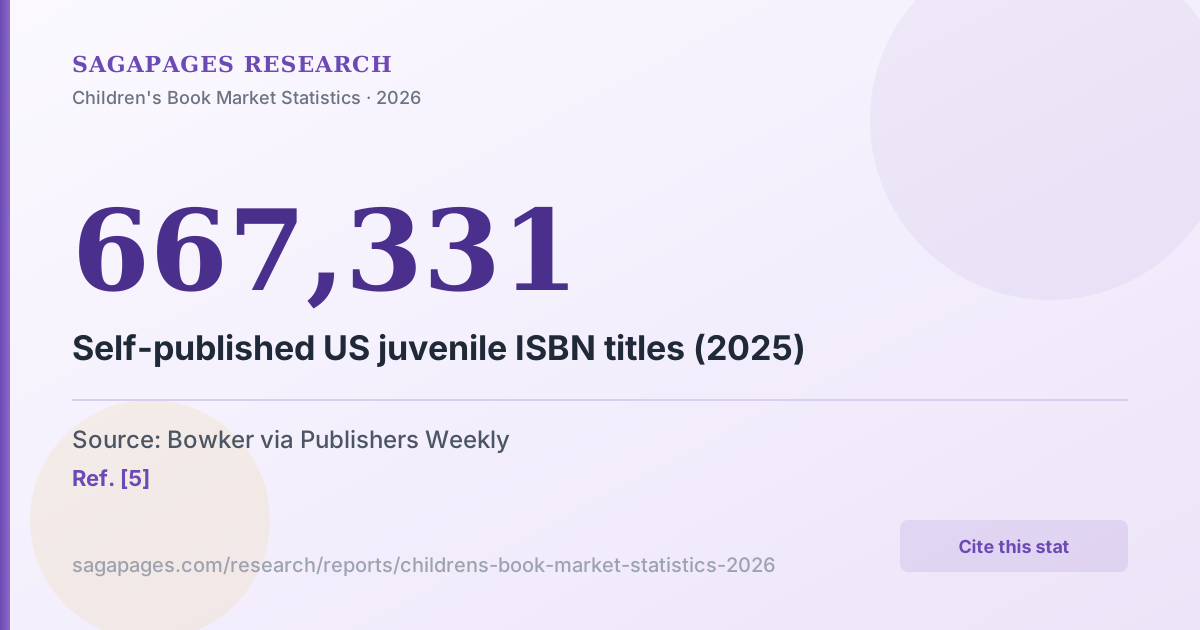
667,331 · US self-published juvenile titles
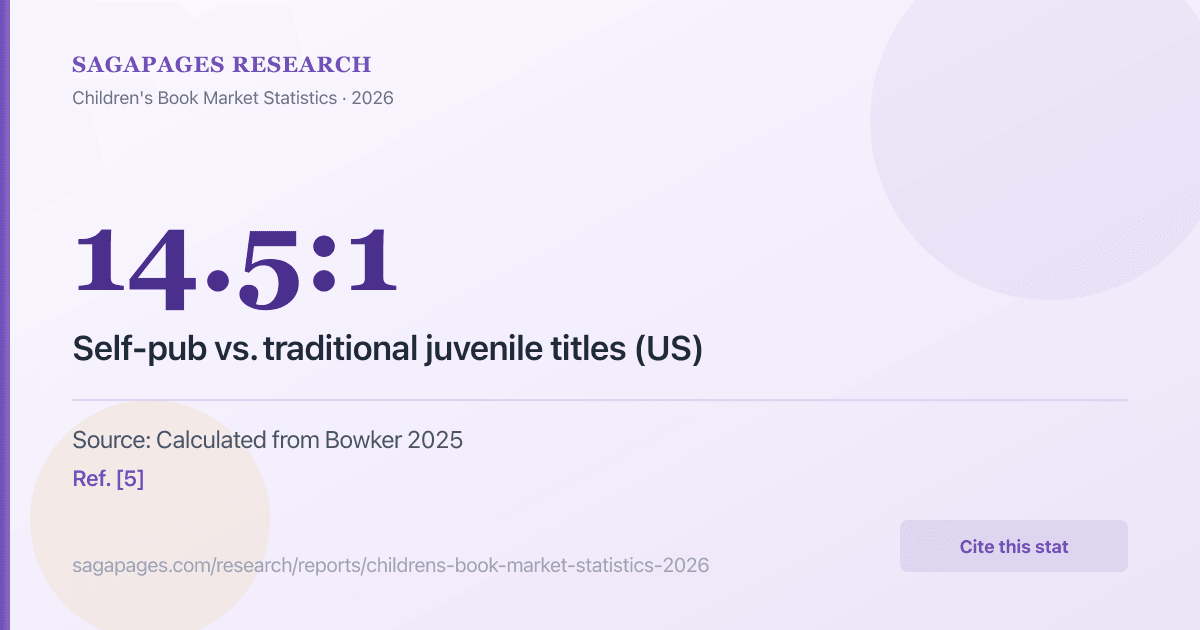
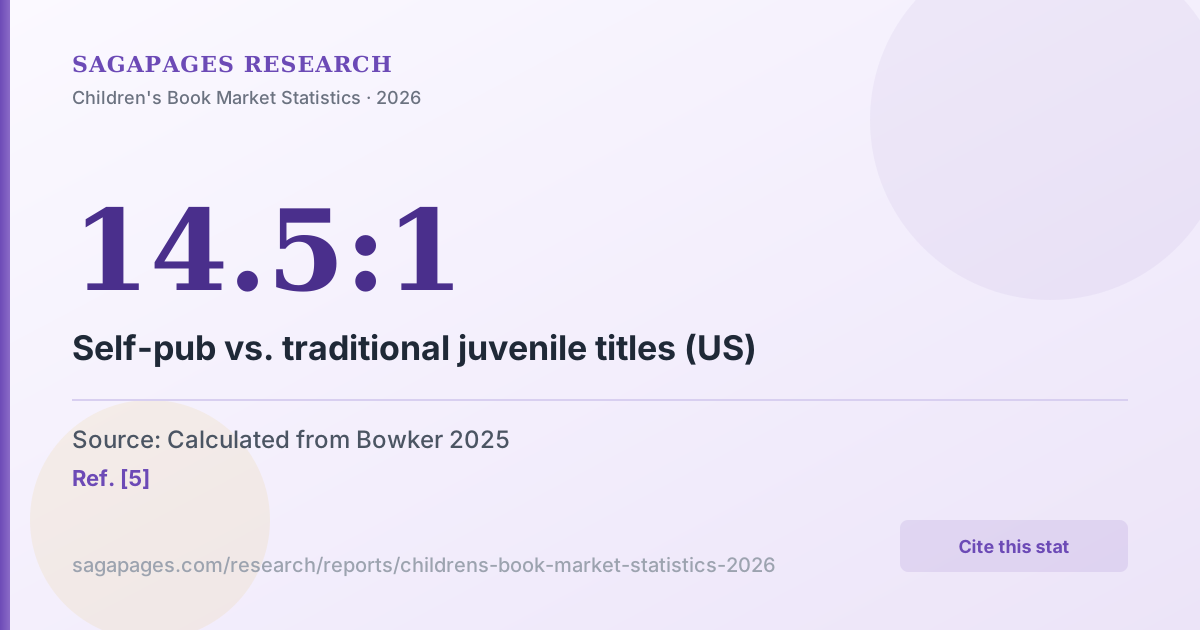
14.5:1 · Self-pub vs. traditional (US)
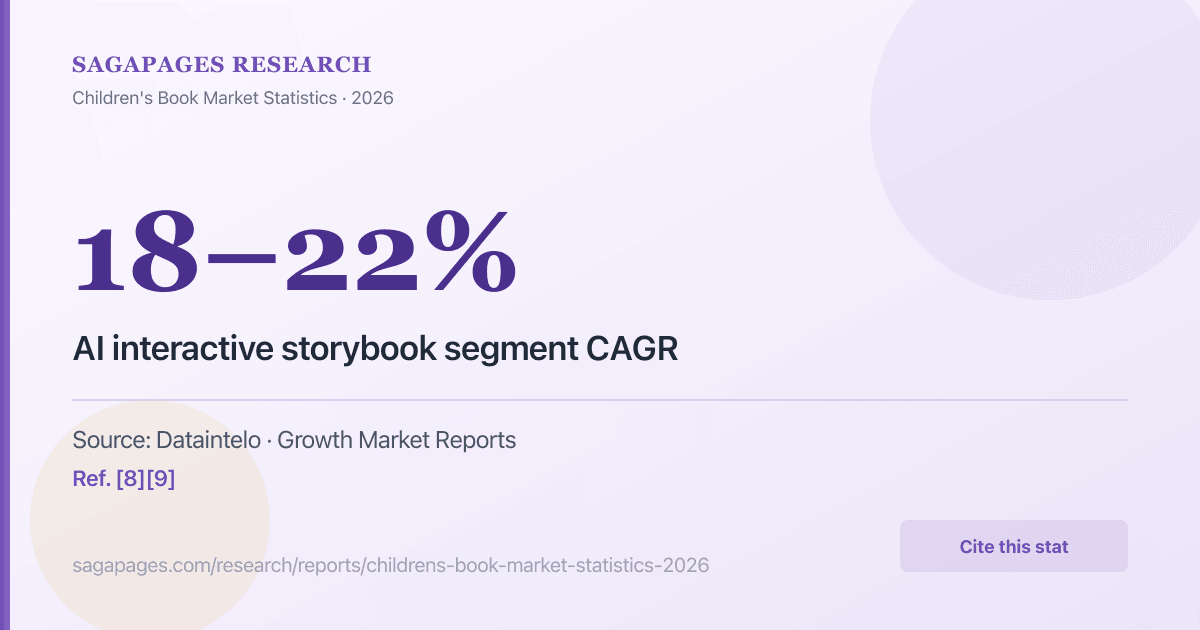
18–22% · AI storybook segment CAGR
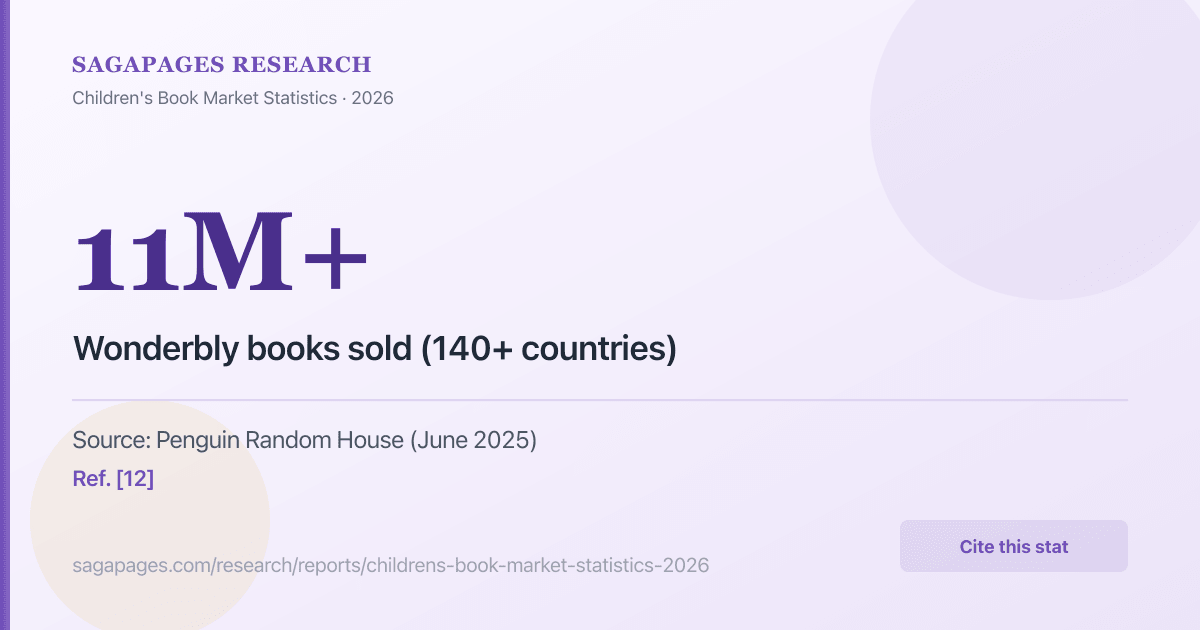
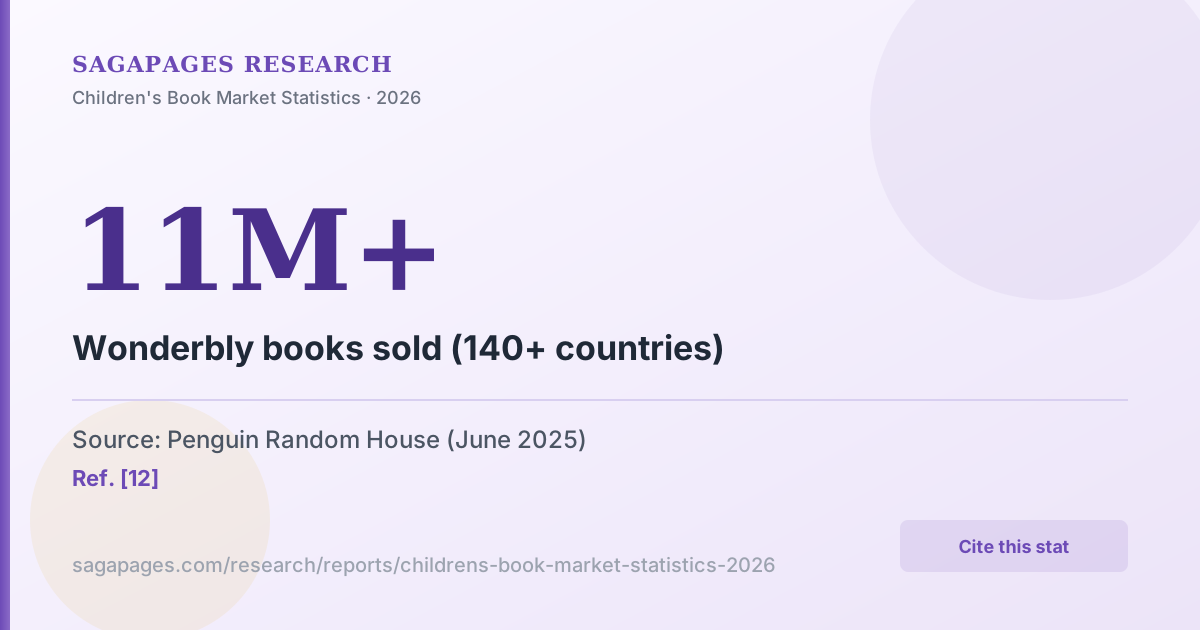
11M+ · Wonderbly books sold
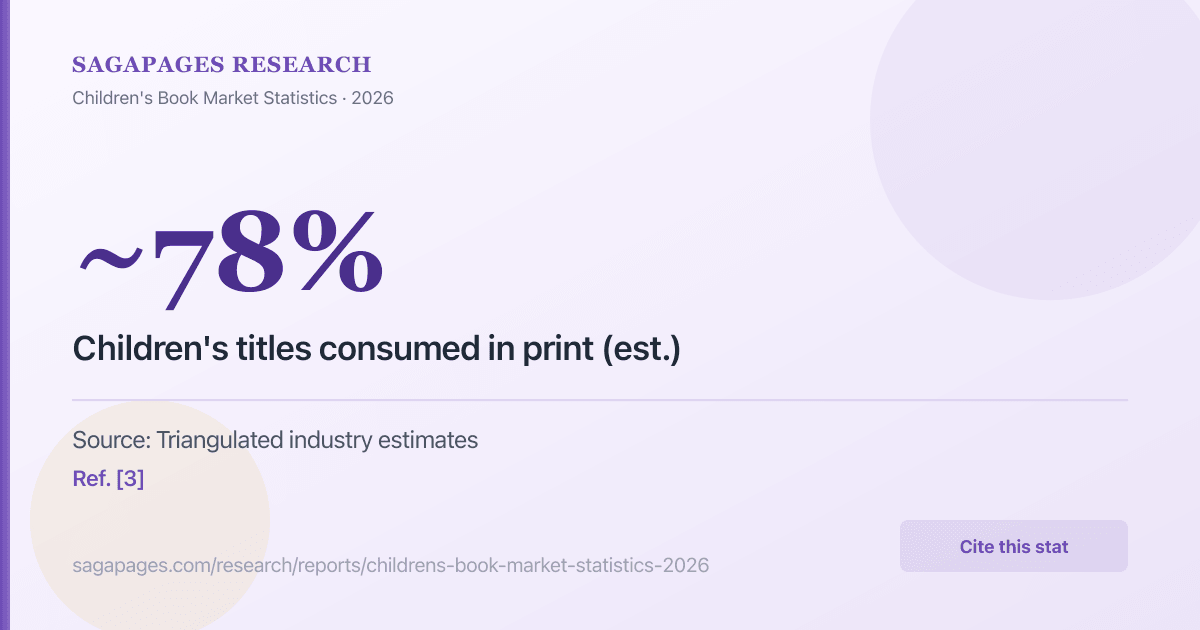
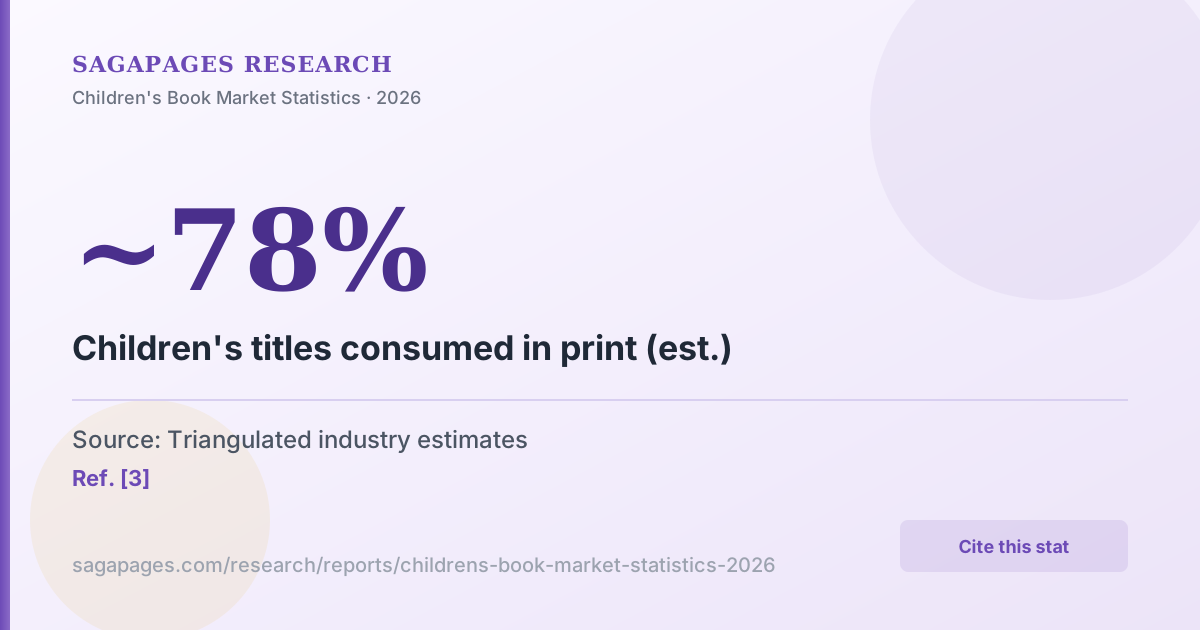
~78% · Print format share (est.)
Cards are 1200×630 px (LinkedIn/Twitter large-card ratio). Hotlink with attribution: https://www.sagapages.com/images/research/cards/childrens-book-market-statistics-2026/[stat-id].png
Global Market Size 2026
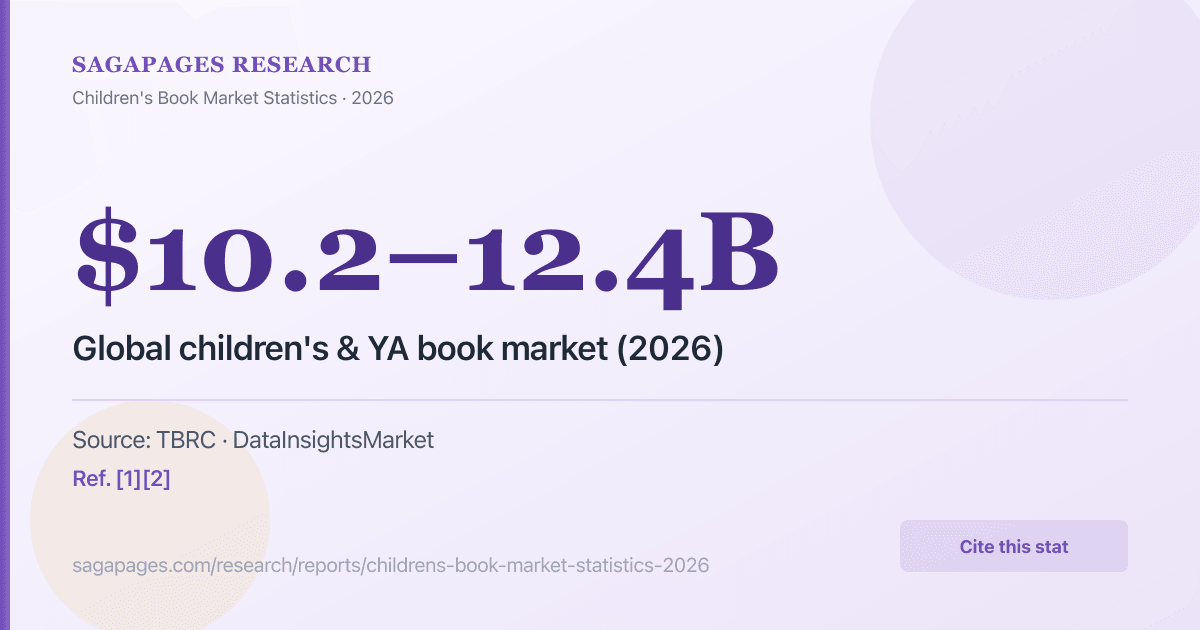
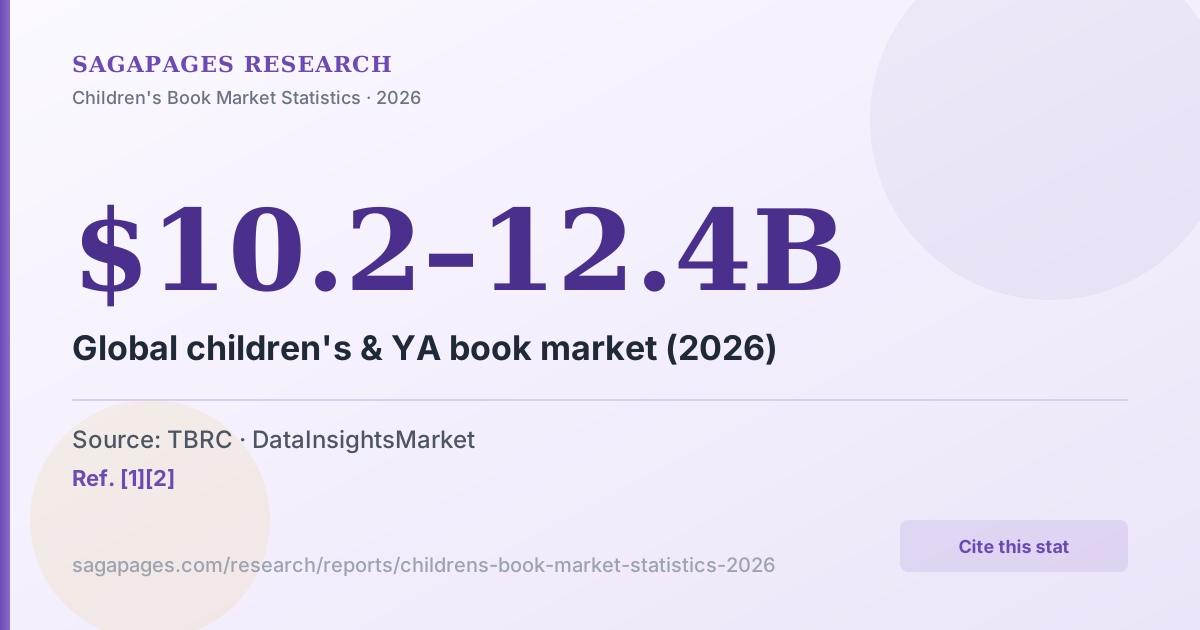
The global children's book market is valued at $10.2 billion to $12.4 billion in 2026, depending on market definition. The variance reflects whether "children's books" includes young adult (YA) titles, audiobooks, and educational materials.
| Source | 2025 Value | 2026 Value | Forecast | CAGR |
|---|---|---|---|---|
| The Business Research Company | $12.16B | $12.44B | $13.81B by 2030 | 2.6% |
| DataInsightsMarket | $10.18B | $10.48B | $11.80B by 2033 | 3.0% |
| IndustryResearch.co | — | $10.15B | $13.29B by 2035 | 3.0% |
| GlobalGrowthInsights | $10.77B | $11.07B | $14.14B by 2035 | 2.76% |
| AbsoluteReports | — | $15.32B | $20.42B by 2035 | 3.25% |
Methodology note: The TBRC figure ($12.44B) includes both children's and young adult books.[1] Narrower children's-only estimates cluster around $10–$11B for 2026.[2][4] Select the definition matching your analytical scope and cite the underlying source—not this summary page—for primary attribution.
Figure 2 — Global market size estimates (2026): source spread
$10.2B
$11.1B
$12.4B
$15.3B
$10B
Consensus band (~$10–11B children-focused)
$16B
Sources: TBRC ($12.44B, incl. YA)[1]; DataInsightsMarket ($10.48B)[2]; GlobalGrowthInsights ($11.07B)[4]; AbsoluteReports ($15.32B, broad scope)[6].
US Market Snapshot
Key insight: In 2025, Bowker recorded 667,331 self-published US juvenile titles (401,716 juvenile nonfiction + 265,615 juvenile fiction) versus 46,051 traditionally published juvenile titles (21,283 nonfiction + 24,768 fiction)—a ratio of 14.5:1.[5] Industry observers attribute much of the 38.7% YoY surge in self-published output to AI-assisted production tools.[5][17]
Growth Trends & Forecasts
The traditional children's book market grows at a steady 2.6–3.0% CAGR.[1][28] This masks dramatic divergence by segment:
Growth by Segment
The AI Disruption Curve
Scope definitions differ materially between syndicators—report both estimates, not a single consensus figure.[8][9]
| Year | Dataintelo Estimate | Growth Market Reports |
|---|---|---|
| 2025 | $3.2B | $1.52B |
| 2030 (est.) | ~$8.5B | ~$3.5B |
| 2034 (projected) | $18.7B | $7.74B |
Production economics (directional): Professional illustration for a trade picture book typically runs $3,000–$10,000 per title; AI storybook platforms charge roughly $2.50–$20 in platform fees per book (plus subscription or credit costs). Exact savings vary by quality bar and revision cycles—treat percentage claims from vendors as illustrative, not audited.[8][43]
Segment activity (vendor-reported aggregate): Industry marketing materials cite >$780 million in disclosed AI storybook funding in 2025 and 60+ active platforms as of early 2026. These figures are useful for trend context but are not independently audited.[8][9]
Market Segmentation Data
By Age Group
Age-band shares are triangulated industry estimates; definitions vary by syndicator (picture books vs. all juvenile formats).[3][35]
| Age Group | Share of Demand | Dominant Format | Notes |
|---|---|---|---|
| Baby – 2 years | ~15–18% | Board books | Early literacy; durable format |
| Ages 3–5 | ~22–25% | Picture books | Peak parental reading frequency |
| Ages 6–8 | ~29% | Early readers, picture books | Largest segment; transition to independent reading |
| Ages 9–12 | ~20–25% | Chapter books, middle-grade | Strong STEM/educational demand |
| YA / Teen | ~10–15% | Novels | Boom-bust cycles tied to franchises |
By Format
Figure 3 — Estimated format mix (children's titles, global)
78%
- Print (total) ~78% — resilient for ages 0–8[3]
- E-books / digital ~12% — minority share; higher among older readers
- Other / interactive ~10% — audiobooks, AR, apps (fastest-growing)
Print share is a triangulated industry estimate; exact percentages vary by age band and geography. Audiobook revenue is growing faster than print unit volume.[1][10]
| Format | Market Share | Trend |
|---|---|---|
| Print books (total) | ~78% | Resilient; tactile preference for young children |
| Paperback | ~45% | Largest print format; affordable |
| Hardcover | ~20% | Gift/collector market |
| Board books | ~15% | Toddlers; durable |
| E-books / Digital | ~12–22% | Growing but minority; only 22% of ages 3–8 use e-books |
| Interactive / AR books | ~8% | Fastest-growing format segment |
| Audiobooks | Rapid growth | $1.79B (2025) → $6.94B (2032), 21.35% CAGR[10] |
By Region
Regional shares vary by source (APAC reported as 29%–37%); cite the syndicator when reproducing a single figure.[1][39]
| Region | Market Share | Key Markets | Growth |
|---|---|---|---|
| North America | 32–35% | US, Canada | Most mature; strong institutional procurement |
| Asia-Pacific | 29–37% | China (38% of APAC), India (29%), Japan (21%) | Fastest-growing; largest child population |
| Europe | 22–28% | Germany (26% of EU), UK (22%), France | Strong library/school networks |
| Latin America | ~6% | Brazil, Argentina | Emerging middle-class demand |
| Middle East & Africa | 8–14% | GCC, South Africa | Government literacy initiatives |
Key Players & Market Share
Trade concentration remains high: the Big Five publishers captured an estimated 70% of picture book bestseller positions and 55% of fiction bestseller positions on Publishers Weekly lists in 2025 (methodology: PW bestseller list analysis).[5][7]
| Publisher | Market Share | Strength |
|---|---|---|
| Penguin Random House | 14–27.4% | Largest globally; 43% of PW picture book bestseller positions |
| Scholastic | 9.4–18% | School distribution; 28.7% of frontlist fiction bestsellers |
| HarperCollins | 10.5–15% | Strong backlist |
| Simon & Schuster | ~19.4% | Fiction bestsellers |
| Hachette Livre | 13–17.7% | — |
| Holtzbrinck / Macmillan | ~12% | — |
The AI Revolution in Children's Books
How AI Is Transforming the Market
Artificial intelligence is impacting the children's book industry across four dimensions:
- Text Generation — LLMs produce age-appropriate story manuscripts in seconds, with vocabulary tuned to age bands.
- Illustration Generation — Diffusion models produce book illustrations. The critical challenge is character consistency across 10–32+ pages. SagaPages uses PuLID (ByteDance's open-source identity-preserving technology) to maintain the same face and outfit.
- Voice & Audio — AI text-to-speech and voice cloning enable narration. Bedtimestory.ai and Readkidz offer AI voice narration; abeiai offers parent voice cloning.
- Personalization at Scale — AI enables real-time generation of customized stories featuring a child's name, appearance, and preferences.
Cost Economics: AI vs. Traditional
| Factor | Traditional Illustration | AI Illustration (2026) |
|---|---|---|
| Cost per book | $3,000 – $10,000 | $2.50 – $20 (platform fees) |
| Time to produce | 3–6 months | 10 minutes – 72 hours |
| Character consistency | Guaranteed (human artist) | 70–95% (varies by tool) |
| Art style flexibility | One style per artist | 15–60+ styles per platform |
| Revision speed | Days to weeks | Seconds to minutes |
| Copyright protection | Full | None for purely AI-generated (US) |
Copyright: The Unresolved Issue
As of mid-2026, U.S. copyright policy requires meaningful human authorship:
- Purely AI-generated works with no human author are not registrable—the D.C. Circuit affirmed this in Thaler v. Perlmutter (March 18, 2025).[15]
- The U.S. Copyright Office's Copyright and Artificial Intelligence, Part 2: Copyrightability Report (September 2025) clarifies that human selection, coordination, or arrangement of AI material may be protectable.[16]
- AI-assisted works with substantial human creative input may qualify for partial registration when properly disclosed.[14]
Amazon KDP: Sellers must disclose AI-generated content; failure to disclose can result in removal or account action.[18]
Academic & Survey Evidence
Evidence on learning outcomes from AI-generated children's content remains emerging and mixed. Treat vendor-sponsored or unpublished survey figures with caution.
"They all look mad with each other." — Parent participant, NC State / McMaster study (2025), on AI illustrations' difficulty conveying emotional nuance[24]
Parent attitudes (NC State / McMaster, Nov 2025): Most parents in the study accepted AI-generated images when text was human-authored and images were expert-vetted—but were not comfortable with AI generating story text. Parents preferred a clear cover label indicating AI use.[24]
Personalization: The Growth Engine
Personalized Children's Book Market Size
| Source | 2024–2026 Value | Forecast | CAGR |
|---|---|---|---|
| Business Research Insights | $0.73B (2026) | $1.5B (2035) | 10.4%[19] |
| Absolute Reports | $679M (2026) | $2.63B (2035) | 16.25%[20] |
| Market Size & Trends | $350M (2024) | $729M (2033) | 8.5%[49] |
| Data Bridge (US only) | $661M (2024) | $1.13B (2032) | 7.10%[21] |
The Wonderbly validation: On June 4, 2025, Penguin Random House acquired Wonderbly, which has sold more than 11 million books in 140+ countries since launch.[12] PRH reported Wonderbly would have contributed roughly €92 million in sales on a full-year basis.[13] Wonderbly continues to operate independently under CEO Asi Sharabi—a signal that major trade publishers view D2C personalization as strategic, not experimental.
Personalization Features Spectrum
| Level | Feature | Example Platforms |
|---|---|---|
| Basic | Name insertion into pre-written story | Wonderbly (classic), iSeeMe! |
| Intermediate | Appearance customization (hair, skin, gender) | Wonderbly, iSeeMe!, Hooray Heroes |
| Advanced | Photo-to-illustrated protagonist | SagaPages, ToonyStory, StorySpark |
| Deep | Full story customization (theme, friends, reading level) | StorySpark, SagaPages (Story Assist) |
| Adaptive | AI narrative adapting to child's reading level | Storybooks.app, StoryWizard.ai |
The Educational Evidence
Natalia Kucirkova (University of Stavanger / The Open University) is the leading academic researcher on personalized children's books:
- Word acquisition (2014): Children showed significantly better word knowledge in personalized sections (First Language journal)[22]
- Digital personalized books (2021): No significant difference in word learning, but children talked more about their own feelings during personalized pages (IJER)[23]
- Children of color (2025, Springer): Personalized books may have particularly great impact on children underrepresented in traditional literature[31]
"The learning potential of personalized books lies in capitalizing on readers' motivation to advance their knowledge with each personalized book." — Natalia Kucirkova, leading researcher on personalized children's books
Bottom line: Academic research confirms personalization boosts engagement and motivation (which drives reading frequency), but evidence on superior knowledge acquisition is mixed.
Competitive Landscape: AI Storybook Platforms
Disclosure: SagaPages operates in this market. Platform comparisons below combine publicly listed pricing/features (March–July 2026) with vendor-reported user counts where noted. Verify pricing before publication; features change frequently. SagaPages is listed alongside peers for transparency—not ranked by independent audit.
Industry estimates suggest 60+ active AI storybook platforms globally (vendor-reported aggregate).[8][9] The segment is moderately fragmented, with wide variance in output quality, safety controls, and print readiness.
Direct Competitor Comparison
| Platform | Core Differentiator | Pricing | Key Feature |
|---|---|---|---|
| SagaPages | Photo-to-character Identity Lock (PuLID); 15 art styles; 15 languages; credits never expire | Freemium + non-expiring credits ($0–$239.99/yr) | Full book workflow; pay-per-successful-page |
| ToonyStory | Photo-to-3D character + animated video | $9.99–$19.99/mo; hardcover ~$29.99 | Closest rival; video output |
| Bedtimestory.ai | Audio-first; 80K+ users | $9.99/mo | AI voice narration; community library |
| Storybooks.app | 50+ languages; reading-level AI | $4.99/mo unlimited | Broadest language support |
| StorySpark | Deepest personalization (friends, toys, pet) | $9.99/mo+ | Class-leading consistency |
| StoryWizard.ai | Most generous free tier (3 stories/mo) | ~$7.99/mo | 11-language narration; safety focus |
| Readkidz | Broadest output (YouTube/KDP publishing) | Freemium | One-click publish; 60+ art styles |
| Wonderbly | Established brand; premium print | ~$30+/book | 11M+ books sold; PRH-owned |
Where SagaPages Fits
SagaPages positions at the intersection of three value propositions:
- Book-grade output — designed for finished, printable storybooks (not one-off images)
- Photo-to-protagonist identity consistency — the child becomes the illustrated hero with the same face on every page (PuLID-powered)
- Transparent, non-expiring credit pricing — pay only for successful page renders; credits never expire (unique vs. monthly-subscription rivals)
Consumer Behavior & Parent Attitudes
Reading Habits
Household reading statistics below are secondary-aggregator estimates (ZipDo/NEA-adjacent). Use for directional context; verify against NEA or Census primary surveys when publishing.[51]
Print vs. Digital Preference
- 63% of parents prefer physical books for their children over digital[3]
- 57% of US parents prefer physical picture books for bedtime reading[35]
- Only 22% of children ages 3–8 use e-book picture books[3]
- Hardcover accounts for 45.18% of English picture book revenue (2025)[35]
- Amazon controls an estimated ~55% of the US online picture book market (channel share estimate)[35]
Diversity & Representation (UK benchmark)
The CLPE Reflecting Realities survey (8th edition, November 2025) is the UK's authoritative benchmark for ethnic representation in children's publishing.[25]
Note: CLPE data covers UK-published titles for ages 3–11 only—not global multicultural theme counts. Do not conflate with US CCBC diversity statistics.
Future Trends 2026–2030
The following trends synthesize product launches, publisher strategy signals, and syndicated forecasts. Timelines are indicative—not guaranteed adoption curves.
Emerging Technologies
| Technology | Status (2026) | Timeline |
|---|---|---|
| AR/VR children's books | ARpedia won CES Innovation Awards; cost and device fragmentation remain barriers[45] | Broader commercial spatial storybooks expected 2027–2028 |
| Voice AI storytelling | Amazon "Create with Alexa"; Google "Tell Me a Bedtime Story"[46] | Voice-first bedtime products expanding |
| AI-adaptive content | Multimodal/interactive formats cited as ~41% of AI storybook segment (syndicator est.)[8] | Longer session times reported vs. static e-books (vendor data) |
| Wearable integration | Early prototyping (2025) | Commercial products possible by 2027 (speculative) |
Traditional Publisher AI Strategy
- Penguin Random House: Acquired Wonderbly (June 4, 2025)[12]
- Scholastic, Pearson, HarperCollins Kids: Industry analysts expect AI-enhanced interactive products between 2026 and 2028 (forward-looking; not confirmed launch dates)
- Green Hill Publishing and others: Restrictive AI policies (no AI for cover, illustration, or editing)[48]
- Chinese publishers report AI-generated content achieving strong sales velocity due to low production costs[52]
Sustainability as Purchase Driver
Environmental impact figures below come from industry sustainability white papers and printer associations—methodologies vary; use as comparative ranges, not universal constants.
| Initiative | Impact (industry estimates) |
|---|---|
| FSC-certified + recycled paper | Up to ~40% smaller carbon footprint vs. virgin fiber (lifecycle-dependent) |
| Soy/vegetable-based inks | Reported 85–92% reduction in VOC emissions vs. petroleum inks |
| Post-consumer waste recycled paper | Diverts landfill waste; reported water/energy savings vary by mill |
| Books meeting safety standards (CPSIA, EN71, etc.) | Compliance reduces exposure to regulated substances in children's products |
Global Expansion Opportunities
- China: 44,187 children's titles published (2024); market projected to reach 520 billion yuan (~$72B) by 2030[52]
- India: 22 scheduled languages; large vernacular market underserved by English-first catalogs[39]
- Special needs market (US): >8 million children with autism, developmental delays, or reading disabilities (CDC/special-education estimates; addressable via adaptive personalization)
- Asia-Pacific AI storybook CAGR: 26.4% (fastest-growing region per syndicated forecast)[39]
Create Your Child's Personalized Storybook
Turn a bedtime idea or your child's photo into a printable, illustrated storybook in ~10 minutes — with the same character on every page.
Try SagaPages Free →Methodology & Editorial Standards
How this report is produced
SagaPages Research compiles this report for journalists, analysts, educators, and investors who need citable, triangulated data on the children's book market. Our editorial process:
- Source hierarchy — Primary: government/regulatory documents, peer-reviewed research, trade press with named methodology (Publishers Weekly/Bowker, PRH corporate releases). Secondary: paid market research syndicators (TBRC, IBISWorld). Tertiary: vendor marketing claims (flagged explicitly).
- Triangulation — When estimates diverge by >15%, we report a range and explain definitional differences (children vs. YA, revenue vs. units, global vs. US-only).
- Recency — Statistics prioritize 2024–2026 publications; forecasts extend to 2030–2035 where noted.
- Corrections — Factual errors are corrected inline with an updated
dateModified. Email support@sagapages.com with source links.
Data limitations (read before citing)
- Global market size spans $10.2B–$15.3B depending on scope—never cite a single figure without naming the source definition.[1][6]
- AI storybook market sizing is nascent; Dataintelo and Growth Market Reports diverge materially on scope.[8][9]
- Bowker ISBN data excludes many Amazon KDP ebooks without ISBNs—true self-published volume is higher.[5]
- Platform pricing/features in the competitive table are point-in-time snapshots—verify before publishing.
- SagaPages has a commercial interest in the AI storybook segment; competitor and product sections include disclosure.
How to cite this report
APA 7th
SagaPages Research. (2026, July 1). Children's book market statistics 2026: The definitive industry data report (Updated 2026-07-20). SagaPages. https://www.sagapages.com/research/reports/childrens-book-market-statistics-2026
Chicago (author-date)
SagaPages Research. 2026. "Children's Book Market Statistics 2026: The Definitive Industry Data Report." Updated July 20, 2026. https://www.sagapages.com/research/reports/childrens-book-market-statistics-2026.
Individual statistics
Cite the original source from the numbered reference list below—not this page—for primary attribution.
Update schedule
Biannual refresh: January and July. Next scheduled update: January 2027. Material market events (major M&A, regulatory changes) may trigger interim updates.
References
Numbered references correspond to in-text citations[n]. URLs verified at time of publication (July 2026).
- Market research The Business Research Company. (2026). Children and young adult books global market report. $12.44B (2026). thebusinessresearchcompany.com/report/children-and-young-adult-books-global-market-report
- Market research DataInsightsMarket. (2026). Children's books market sizing ($10.48B, 2026). Cited via industry aggregators.
- Market research IndustryResearch.co / GlobalGrowthInsights. (2026). Format segmentation and print share estimates.
- Market research GlobalGrowthInsights. (2026). Children's books market ($11.07B, 2026).
- Primary data Publishers Weekly. (2026). Book output topped four million in 2025 (Bowker ISBN statistics). publishersweekly.com/…/99943-book-output-topped-4-million-in-2025
- Market research AbsoluteReports. (2026). Children's books market ($15.32B, broad definition, 2026).
- Market research IBISWorld. (2025–2026). Children's book publishing in the US (OD4301). Revenue and profit margin estimates.
- Market research Dataintelo. (2025–2026). AI interactive storybook market forecasts (CAGR ~21.8%; $18.7B by 2034).
- Market research Growth Market Reports. (2025–2026). AI storybook market alternate scope ($1.52B base; $7.74B by 2034).
- Market research PW Consulting / industry syndicators. (2025). Children's audiobook market projections ($1.79B → $6.94B, 21.35% CAGR).
- Industry Jane Friedman. (2026). Analysis of Bowker 2025 ISBN data and AI-driven volume surge. janefriedman.com/book-output-tops-4-million-in-2025-in-the-us
- Primary Penguin Random House. (2025, June 4). PRH acquires Wonderbly. global.penguinrandomhouse.com/announcements/prh-acquires-wonderbly…
- Industry Publishers Weekly. (2026). PRH profits report; Wonderbly €92M full-year sales contribution. publishersweekly.com/…/97944-prh-buys-u-k-based-wonderbly
- Regulatory U.S. Copyright Office. (2023). Copyright registration guidance: Works containing material generated by artificial intelligence. copyright.gov/ai/ai-policy-guidance.pdf
- Legal Thaler v. Perlmutter, D.C. Cir., March 18, 2025 (human authorship requirement). Cleary Gottlieb analysis
- Regulatory U.S. Copyright Office. (2025). Copyright and artificial intelligence, Part 2: Copyrightability report. copyright.gov/ai/…Part-2-Copyrightability-Report.pdf
- Industry BoSacks / Publishing Executive. (2026). Commentary on Bowker 2025 data and AI-assisted self-publishing surge. bosacks.com/…/four-million-books-and-the-question-nobody-wants-to-ask
- Platform policy Amazon Kindle Direct Publishing. (2026). AI-generated content disclosure requirements for KDP publishers.
- Market research Business Research Insights. (2026). Personalized children's books market ($0.73B, 2026).
- Market research Absolute Reports. (2026). Personalized children's books ($679M, 2026; 16.25% CAGR).
- Market research Data Bridge Market Research. (2024). US personalized children's books ($661M, 2024).
- Academic Kucirkova, N., Messer, D., & Whitelock, D. (2014). Reading personalized books with preschool children. First Language, 34(3), 227–243.
- Academic Kucirkova, N. (2021). Digital personalized books. International Journal of Educational Research. Engagement and talk-time findings.
- Academic NC State University & McMaster University. (2025). Parent attitudes toward AI-generated images in children's books. Industry presentation/survey.
- Primary Centre for Literacy in Primary Education (CLPE). (2025). Reflecting Realities report (8th ed.; 2024 UK publications). clpe.org.uk/research/clpe-reflecting-realities… · PDF
- Industry The Bookseller. (2025, June 4). Penguin Random House buys Wonderbly. thebookseller.com/news/penguin-random-house-buys-wonderbly
- Industry Publishers Lunch. (2025, June 4). Acquisitions: PRH buys Wonderbly. lunch.publishersmarketplace.com/2025/06/acquisitions-prh-buys-wonderbly
- Market research 360iResearch. (2026). Children's books market ($10.99B, 2026; 5.88% CAGR to 2032).
- Market research Research and Markets. (2026). TBRC children & YA books report distribution. researchandmarkets.com/reports/5939605…
- Legal Skadden, Arps. (2025). Appellate court affirms human authorship requirement (Thaler). skadden.com/insights/…/appellate-court-affirms-human-authorship
- Academic Springer. (2025). Personalized books and children underrepresented in literature. Peer-reviewed study cited in personalization section.
- Industry National Literacy Trust (UK). Children's reading habit surveys; library circulation context.
- Industry Cooperative Children's Book Center (CCBC), University of Wisconsin–Madison. US diversity statistics (distinct from CLPE UK methodology).
- Industry EdSurge / industry surveys. Parent willingness-to-pay for personalized digital reading (use with caution—survey methodology varies).
- Market research Statista. Children's publishing market charts; regional share corroboration.
- Market research Grand View Research. Children's publishing and educational content market segments.
- Industry NAEYC. Early literacy and picture book consumption guidance for educators.
- Industry Inclusive Books for Children (IBC). UK representation advocacy; complementary to CLPE.
- Market research QYResearch / Congruence Market Insights. APAC children's book growth estimates.
- Market research WiseGuy Reports / IntelMarketResearch. Interactive & AR children's book segment sizing.
- Industry SelfPublishing.com. (2026). Publishing by the numbers (Bowker analysis, KDP context). selfpublishing.com/publishing-by-the-numbers
- Industry Literacy Hive. (2025). Reflecting Realities 2025 headlines. literacyhive.org/reflecting-realities-survey-2025-the-headlines
- Platform SagaPages. (2026). Platform pricing, feature set, and PuLID-based identity consistency (vendor-reported; company disclosure).
- Technology ByteDance. PuLID open-source identity-preserving diffusion (referenced in AI illustration section).
- Industry CES Innovation Awards. ARpedia recognition (AR children's books).
- Industry Amazon / Google. Voice AI storytelling products ("Create with Alexa"; "Tell Me a Bedtime Story").
- Market research Proficient Market Insights. Middle East & Africa children's book market growth.
- Industry Green Hill Publishing. AI policy statements (restrictive illustration policies).
- Market research Market Size & Trends. Personalized books ($350M, 2024 base).
- Academic Journal of Educational Technology. (2025). Meta-analysis on digital reading tools (cited in AI learning outcomes context).
- Industry ZipDo / NEA-adjacent reading statistics. Household book ownership estimates (secondary aggregator—verify against NEA primary where possible).
- Regulatory China NPPA. Children's publishing volume statistics (2024 titles; market projections to 2030).